
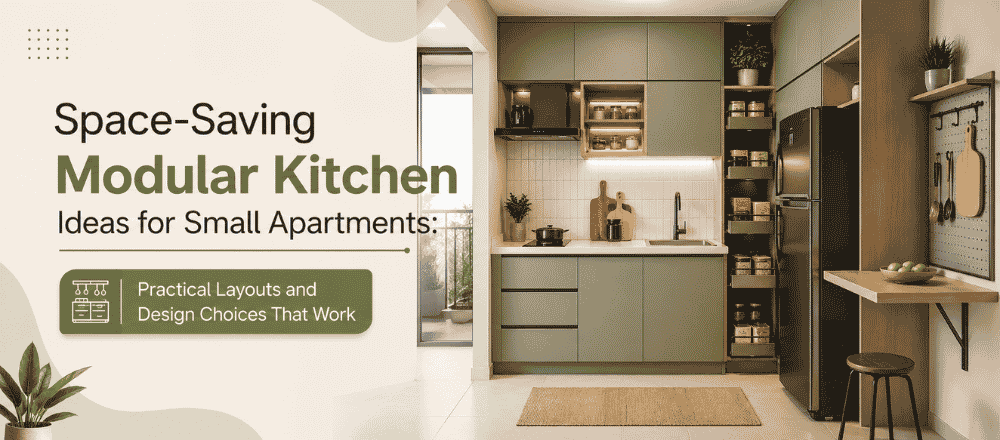
Most compact kitchens underperform not because of square footage, but because of poor spatial planning, restricted movement, and design choices, that prioritise visual appeal over daily function.
Modular kitchen design addresses these challenges at a structural level. By working within fixed dimensions, optimising workflow, and using purpose-built storage systems, it allows small kitchens to operate efficiently, without feeling crowded. In this blog, we are sharing some space-saving modular kitchen ideas that work for small apartments:
Choose a Layout That Matches the Room
Forcing an unsuitable layout into a small apartment leads to blocked walkways and underused cabinets. The objective should be to create an uninterrupted movement between the sink, hob, and refrigerator. Here is how different layout will fit into your kitchen:
- Straight kitchens are best for narrow rooms as they keep all functions on one wall, preserves circulation space and simplifies movement.
- L-shaped kitchens work well when a corner is available, allowing cooking and washing zones to remain distinct, without expanding footprint.
- Parallel kitchens are efficient, only if the aisle between counters is planned carefully. Anything narrower than 1000 mm restricts movement and reduces comfort.
Prioritise Vertical Storage Over Wider Cabinets
Floor area is the biggest constraint in small apartments, but you can use the vertical height to its fullest.
Tall modular cabinets extending close to the ceiling, increase storage capacity, without increasing the kitchen’s footprint. These upper sections are ideal for items used occasionally, such as bulk groceries, backup utensils, or appliances.
Moreover, to prevent visual heaviness, you can pair these cabinets with lighter finishes or handleless shutters. This keeps the kitchen visually balanced, while maximising usable storage.
Replace Shelves with Drawers and Pull-Out Systems
Traditional shelves waste usable department and items placed at the back are hard to access and often forgotten.
Instead use drawers and pull-out units that bring contents forward, making every inch usable. In compact kitchens, this improves both storage density and accessibility. Moreover, deep drawers can hold cookware, stacked utensils, or dry storage, more efficiently than fixed shelves.
When you segment internal systems, it helps in reducing clutter by assigning clear storage zones, which is essential in limited spaces.
Treat Corners as Functional Zones
Corners are often the least efficient part of a small kitchen. On top of that, blind cabinets and poorly designed rotating systems tend to become inaccessible over time.
In some cases, it is better to simplify corner usage and gain efficiency elsewhere, through wider drawers or continuous counter space. When corner storage is used, systems should allow full access to contents, rather than partial rotation.
Integrate Appliances to Free Counter Space
Freestanding appliances quickly consume usable work areas. Built-in appliances such as ovens, microwaves, and dishwashers integrate into modular units, reducing surface clutter and improving workflow. For small appliances used daily, dedicated pull-outs or shuttered cabinets keep counters clear, without sacrificing accessibility. Ensuring a clear countertop instantly improves, how spacious and functional a kitchen feels.
Use Finishes That Reduce Visual Weight
Heavy finishes make small kitchens feel closed in, whereas light-reflective surfaces help open up the space visually.
Uniform finishes across upper and lower cabinets prevent visual fragmentation. Additionally, matte finishes reduce glare, while maintaining a clean appearance, and lighter tones help reflect both natural and artificial light.
Opt for Handleless or Slim Handle Shutters
Handles affect both movement and maintenance and protruding handles interfere with circulation in tight kitchens and add unnecessary visual breaks.
Handleless designs or slim-profile handles keep cabinet fronts flush, improving movement and making surfaces easier to clean. This small detail has a noticeable impact on usability in compact layouts.
Efficiency That Comes from Purposeful Design
When layouts are chosen thoughtfully, storage is built around real habits, and finishes are selected for durability rather than trend value, even compact kitchens can function comfortably over the long term.
If you’re planning a kitchen or storage system for a smaller home, it helps to work with teams that understand modular construction, beyond surface design. Nexus Interio deal with modular systems at a structural level, from internal configurations to finish performance, can help translate space limitations into practical, lasting solutions. Ready to design a kitchen that works for you? Get in touch with us today!
