
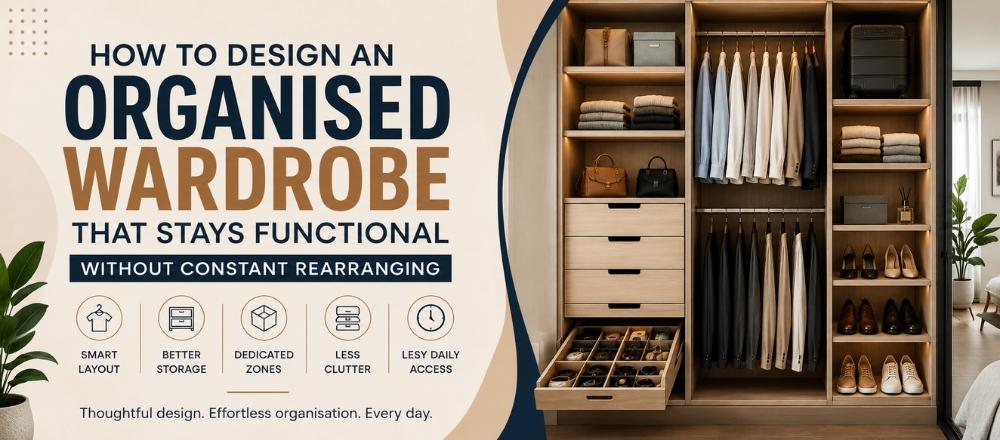
Most wardrobes don’t fall apart because the storage isn’t planned around real use. Clothes pile up where there’s space, accessories drift into random drawers, and items worn daily end up buried behind things you rarely touch.
Understanding how to design an organised wardrobe starts with accepting that organisation is built into the structure, not maintained through constant effort. When internal layouts support everyday habits, wardrobes stay tidy without repeated rearranging.
Start with What You Own, Not What Looks Good on a Layout
Wardrobe design often begins with cabinet sizes; instead it should begin with clothing categories.
Daily wear, work clothes, ethnic wear, accessories, footwear, and seasonal items all require different types of storage. Treating them the same leads to overcrowding in some sections and unused space in others. An organised wardrobe works when each category has a defined zone.
- Long garments need uninterrupted height
- Folded clothes need stable shelves or drawer
- Accessories need shallow, visible compartments
This clarity prevents clothes from migrating into the wrong spaces over time.
Design Storage Around Daily Access
One of the fastest ways wardrobes become messy is poor access planning. Clothes worn daily should sit between waist and eye level. Items used occasionally can move higher or lower. When frequently used pieces are difficult to reach, they end up being placed wherever space is available. This principle sits at the core of how to design an organised wardrobe that holds its structure. When access matches frequency of use, clothes naturally return to their place.
Use Drawers to Control Clutter, Not Just Add Storage
Open shelves encourage stacking, and stacking hides clothes. Drawers bring items forward and limit how much can be stored in one section. Internal dividers further improve control by separating clothing types such as loungewear, innerwear, or gym wear. In compact wardrobes, replacing a few shelves with well-planned drawers often improves organisation more, than adding extra storage units.
Plan Hanging Sections with Precision
Proper hanging layout is a practical step in how to design an organised wardrobe that remains usable over time.
But often this space is planned incorrectly, usually without considering how different garments actually need to hang. Shirts are given more height than necessary, while longer clothing is squeezed into tighter sections. This leads to wasted vertical space and unnecessary wear on clothes over time.
Different garments require different clearances. Shirts, trousers, dresses, and outerwear should ideally be separated into distinct hanging zones. This improves visibility, reduces creasing, and prevents overcrowding.
Give Accessories Their Own Dedicated Zones
Accessories are often treated as an afterthought, which is why they tend to create clutter. Belts, scarves, ties, jewellery, and watches need shallow drawers or pull-out organisers, that keep them visible and easy to access. When accessories have their own defined storage, they stay out of clothing drawers and off shelves, preventing spillover and keeping the wardrobe balanced overall.
Keep the Internal Layout Simple and Repeatable
Too many storage variations make a wardrobe harder to maintain over time. When internal elements are consistent, wardrobes stay organised longer. Repeating drawer sizes, uniform shelf depths, and clearly defined zones, make it easier to return items to their place without thinking.
This kind of simplicity is central to how to design an organised wardrobe that works in real life, not just on installation day.
Design for Quick Daily Reset
A wardrobe should support rushed mornings rather than rely on everything being put back just right. When storage only works if clothes are placed a certain way, disorder becomes inevitable.
Drawers that allow flexible folding, hanging sections with enough breathing room, and shelves that hold their shape after a busy day, make it easier for the wardrobe to reset itself. Organisation should hold up to daily use, not work against it.
Organisation That Lasts Comes from Thoughtful Planning
Organisation that lasts comes from wardrobes that are planned to support real routines, changing storage needs, and everyday use without constant adjustments. When internal layouts are clear, access is intuitive, and storage zones are designed with purpose, wardrobes remain functional long after the initial setup.
This is where experienced planning matters. Nexus Interio designs modular wardrobes with a strong focus on internal configuration, load distribution, and long-term usability. Their team understands how wardrobes are actually used over time. If you’re planning a new wardrobe or upgrading an existing one, get in touch with Nexus Interio to explore solutions that stay organised effortlessly.
